Anunțuri
Welcome! You’re about to dive into a guide perfect for those who love cards. Whether you’re a hobbyist, a magician, or just someone who enjoys a good game. This guide will help you master cards. You’ll learn the basics, key techniques and sleights, and even advanced routines. We’ll also cover how to take care of your decks and strategies for popular games like poker and blackjack.
Plus, we’ll get into how to keep your cards in top shape. You’ll learn how to pick the best decks from top brands like Bicycle, Tally-Ho, Theory11, and USPCC. And we’ll share tips on what makes a deck durable and easy to handle. Ready for friendly and useful tips and tricks? We’ll show them to you step-by-step. You can start practicing these tips tonight.
Anunțuri
This article has ten sections. They’re arranged to take you from basic skills to more advanced techniques. You’ll learn step by step. This way, you can build your skills bit by bit. Keep reading for insights on card care, handling, and game strategies. We’ll also recommend the best playing cards for various needs and budgets.
Concluzii cheie
- This article is a practical, step-by-step card guide for players and performers.
- Topics include fundamentals, sleights, advanced routines, and deck care.
- Brand notes cover Bicycle, Tally-Ho, Theory11, and USPCC for buying decisions.
- Focus on short practice sessions to build muscle memory and consistency.
- Later sections offer game-specific strategy and resources for ongoing learning.
Understanding the Basics of Card Games and Decks
Start by exploring the wide world of card games. Each type of game needs specific skills and setups. Games played at home like Hearts or Uno are more laid-back. But, Texas Hold’em and Blackjack in tournaments or casinos follow strict rules.
Common card game types and formats
There are trick-taking games such as Bridge, Spades, and Hearts where winning tricks is key. Shedding games, for example Crazy Eights and Uno, aim to get rid of all your cards. War focuses purely on the rank of cards to win.
Vying and hand-ranking games include Poker types like Texas Hold’em. Casino table games feature Blackjack and Baccarat. Meanwhile, Magic: The Gathering and Pokémon are popular in collectible and card-battle formats.
Playing casually at home or with friends usually means easy-going rules. Tournaments and casinos, however, stick to strict rules and have penalties for mistakes.
Standard deck components and card terminology
A regular deck has 52 cards divided into four suits: hearts, diamonds, clubs, and spades. They include cards from Ace to King. Some decks also have jokers for certain games.
Cards have pips, face cards, and indices at the corners. Magicians might use special cards for tricks. Familiarize yourself with terms like hand, flush, and trick for better play.
Knowing your card’s details, like the indices and corners, helps in fast decision-making. Indices let you quickly see a card’s suit and rank during a game.
How to read and evaluate a card quickly
Quickly reading a hand starts with the indices. Check the corners to understand the card’s suit and rank fast. Then, organize your cards by suit to see potential flushes or shortages.
In poker, identify pairs and connectors quickly. Count the cards that could improve your hand. In trick-taking games, keep an eye on high cards for a win.
Always evaluate cards based on the game’s objectives. For meld games, look for sets and runs. In casinos, consider the high and low values of cards. Magicians should look for unique marks on the card backs.
| Category | Typical Games | What to evaluate first |
|---|---|---|
| Trick-taking | Bridge, Spades, Hearts | High cards and suit length to control tricks |
| Shedding | Crazy Eights, Uno variants | Playable ranks and cards that block opponents |
| Vying/Hand-ranking | Texas Hold’em, Omaha | Pairs, suited connectors, outs for draws |
| Comparison | War | Highest single-card value |
| Casino | Blackjack, Baccarat | Card values and composition of the shoe |
| Collectible | Magic: The Gathering, Pokémon | Card formats, synergies, and deck curve |
Essential Card Techniques for Beginners
Good fundamentals enhance every card session. This section explores safe shuffling, basic card tricks, and practical practice habits. It’s all about keeping your cards in top shape and boosting your confidence, whether you’re at a card table or performing onstage.
Shuffling methods that protect card integrity
Begin with gentle riffle shuffles using decks like Bicycle or USPCC to prevent damage. Experiment with wet and bridge shuffles using light pressure from your fingers, ending with a bridge to align the deck neatly. For quick mixes without harming the edges, try overhand shuffles.
The Hindu shuffle and a wash or table overhand are great for thorough mixing with minimal card stress. If you want to avoid damage to the edges, opt for a strip shuffle or a table riffle. Make sure your hands are dry, apply gentle force, and use a felt mat for practice to minimize wear. By adjusting how you hold and move cards, you can extend their lifespan significantly.
Simple sleights and handling for smooth play
Start with basic sleights to enhance your card handling. Master the double lift and a simple false cut as your first steps. Incorporate the mechanics’ grip, retention of vision, and an easy palm trick to subtly manage single cards. These techniques make your routines more impressive without needing complex tricks.
Pay attention to how you hold and move cards. Keep your grip firm yet relaxed. Use your thumbs for guidance and fingertips for precise actions. Keep your wrists straight to avoid discomfort. Remember, use your sleight of hand for entertainment and games, not for cheating.
Practice routines to build muscle memory
Short, focused practice sessions work best. Spend 10–20 minutes on a single technique. For instance, practice 10 riffle shuffles, do 50 overhand shuffles, work on 20 double lifts in groups of 5, and deal 52 cards quickly to improve your speed and precision.
Increase your pace gradually as you practice. Record yourself to identify any tension or bad habits. Using a metronome or timer can help you maintain a steady rhythm. Stop practicing before you feel tired to avoid straining your wrists and to keep your movements sharp.
| Focus Area | Drill | Duration | Key Tip |
|---|---|---|---|
| Shuffling methods | 10 riffle shuffles, 50 overhand shuffles | 10 minutes | Use Bicycle/USPCC decks, finish with bridge, keep hands dry |
| Card sleights | Double lifts in sets of 20, basic palm repeats | 10–15 minutes | Start slow, maintain mechanics’ grip, focus on relaxed tension |
| Card handling | Timed full-deck deals, table riffle practice | 5–10 minutes | Use felt mat, practice strip shuffle to protect edges |
| Practice routines | Video recording and metronome-paced sets | 5–10 minutes | Progressive repetition, avoid overtraining wrists |
Advanced Card Strategies and Tricks
Move past the basic card skills with new techniques. This part goes into rehearsal tips, psychological strategies, and combining little effects into big magic shows. Make sure your moves are smooth and hidden by pacing yourself well.
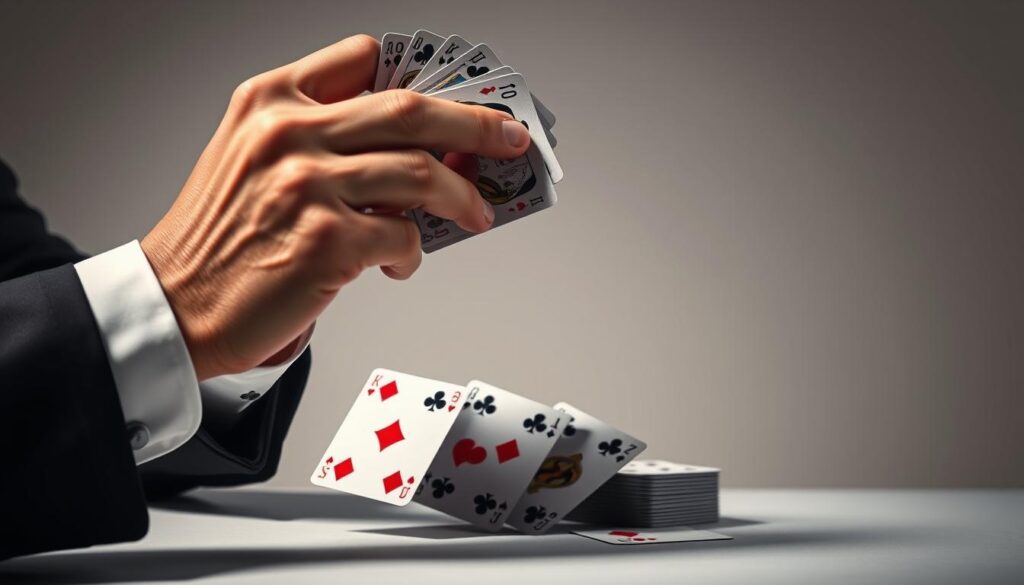
Controlled cut şi false shuffle make it seem like you’re mixing the cards fairly. Using the Zarrow shuffle helps keep the deck in order while it looks like you’re shuffling for real. Get good at different shuffles to keep your secret safe. Doing push-through cuts helps with tricks that need a specific card to stay in place.
To make these tricks work, keep your movements natural and your timing relaxed. If you look nervous, people will notice. Your movements should be small and match your talking. Practice each move until you can do it without thinking.
Misdirection uses different ways to keep eyes where you want them. Say something to move their gaze, use a joke to distract them, or pause to make them expect something. Learn from experts like Banachek and Eric Mead, and watch David Blaine for tips on timing. The moment you choose to divert their attention can cover up a sneaky move.
Keep it simple for the best effect. Ask a question to mislead them as you do a tricky move. A tap can help change their focus, and counting cards secretly works too. Always pair these strategies with skilled techniques, so the trick is not just about fooling them.
Create a story with your magic show that has a beginning, middle, and end. Start with a brief setup to get everything in place. Add a twist or challenge in the middle to make it interesting. Finish with a big moment that they’ll remember. Make sure every move counts and avoid doing the same thing twice.
Plan what you’ll say and practice moving smoothly between tricks. Show your friends and see what parts they like best. You might use special cards, but don’t rely on them too much. Focus on the magic, so that’s what people remember, not the props.
| Technique | Purpose | Practice Focus |
|---|---|---|
| Zarrow shuffle | Simulate riffle while keeping pack order | Keep even riffling sound and steady tension |
| False overhand shuffle | Appear to mix cards while preserving sequences | Smooth thumb motions and consistent packet sizes |
| Push-through cut | Control a card to the top or bottom discreetly | Timing with patter and relaxed hand positions |
| Retention count | Hide cards during a dealing sequence | Natural counting rhythm and steady eye contact |
| Verbal misdirection | Shift audience focus through speech | Patter writing and practiced pauses |
| Routine structuring | Create a satisfying narrative arc | Trim redundant moves and rehearse endings |
Card Maintenance: Care, Storage, and Protection
Good card maintenance begins with daily habits that are easy to follow. Keeping your hands clean, your table tidy, and handling your decks gently makes them last longer. By doing small things, you can prevent big damage and keep your cards in good shape for playing and showing off your skills.
Cleaning and preserving playing surfaces
Clean tables and mats with a cloth that doesn’t leave lint before you start playing. If anything spills, gently clean it up with a mild soapy water solution and then dry it carefully. Stay away from cleaners that are oily because they can leave a film on cards that attracts dirt.
Using felt or baize mats can give you a smooth surface that’s great for card tricks and fancy moves. If you use your table a lot, think about getting a protector from Gametable or Stag. And always keep your drinks and snacks away from where you’re playing to avoid accidents.
Before you touch your cards, either wash your hands or use a lotion that isn’t greasy. This helps keep the cards clean and in good condition by reducing the oil and sweat that can damage them.
Best storage solutions to prevent warping
Keep your decks in their original boxes or in hard plastic cases to protect their shape. Store them somewhere cool and dry, out of the sun and away from moist air. Avoid places like attics, car trunks, and bathrooms because too much heat and humidity can ruin your cards.
Storing cards upright can help stop them from bending. Companies like Ultimate Guard and BCW have special boxes for keeping several decks neatly without squishing them. Throw in some silica gel packs to absorb excess moisture and your cards will stay nice for a long time.
When to retire a deck and how to recycle cards
When your cards start showing wear, like rounded or torn corners, bends that won’t straighten out, or if they feel sticky, it’s probably time to get a new deck. Decks used in money games might need replacing faster than those you just practice with.
You can turn old cards into things like artwork, coasters, or educational tools. Think about giving still-usable decks to schools or theaters. While not all recycling centers take laminated paper, be sure to ask first. Also, look for companies that make playing cards out of recycled materials for an eco-friendly option.
| Issue | Quick Fix | When to Replace |
|---|---|---|
| Oily fingerprints | Wipe with lint-free cloth, wash hands before play | If residue persists after cleaning |
| Warping or bending | Move cards to a rigid case and control humidity | When cards no longer lie flat for shuffles |
| Frayed or rounded corners | Trim stray fibers gently, store upright | When corners affect deals or reveals |
| Faded or worn faces | Limit use to practice; separate decks by purpose | When card faces reduce reliability or aesthetics |
| Sticky residue | Spot-clean with mild detergent; dry thoroughly | When tackiness returns after cleaning |
Choosing the Right Card for Your Style
Choosing the right deck is crucial. It changes how you play, practice, and perform. Some players prefer tough casino decks for table games. Others might look for magic decks. They are thinner and have special cards for tricks. Casual fans search for a good mix of feel, price, and durability in their cards.
Differences between casino, poker, and magic decks
Casino-grade decks, like Bee and Monarch, are made for lots of use. They are cut precisely and print consistently for fairness and durability. Poker-sized decks have bigger faces that are easier to read. Bridge-sized decks are better for those who like holding thinner hands.
Magic decks are usually lighter and have unique designs on the back. They might have special cards for doing tricks. Decks for cardistry focus on looks and smooth handling. This makes performing complex moves easier.
Card materials, finishes, and how they affect handling
Most decks are made from compressed fibers. Their thickness and weight influence how you shuffle and handle them. Thinner decks are easier to control. But, thicker ones can last longer and resist bending.
The finish on a deck affects its feel and how it performs. Bicycle decks have an air-cushion finish that provides a bouncy shuffle. Linen or embossed finishes offer better grip and a traditional appearance. Decks coated in plastic are good against moisture and easy to wipe clean, though they might be too slippery for certain tricks.
Brand comparisons and budget options
Bicycle is known for making decks that are both good and affordable. Tally-Ho is a favorite among magicians for its grip and reliability. Theory11 and Ellusionist offer decks that are both pretty and high-quality.
Cartamundi makes decks for casinos and collectors that feel smooth. Bee and Monarch decks are known for their use in casinos. For those watching their spending, decks from Walmart or Target are good for practice. Amazon might offer generic decks, but their quality varies.
Trying a few different types of decks can help find the right one for you. A mixture of casino decks, magic decks, and a cardistry pack should meet most needs.
| Use | Typical Brands | Key Traits | Best For |
|---|---|---|---|
| Casino play | Bee, Monarch, Cartamundi | Durable stock, tight cut, consistent print | Casinos, heavy table use |
| Magic | Tally-Ho, Bicycle, Theory11 | Thin or flexible stock, gaffs available, good grip | Sleights, close-up tricks |
| Cardistry | Theory11, Ellusionist, custom brands | Smooth finishes, bold art, low friction | Flourishes, performance visuals |
| Budget practice | Walmart/Target brands, generic Amazon decks | Affordable, variable quality, replaceable | Daily drills and new learners |
Card Game Strategy: Winning Tips for Popular Games
Playing strong begins with understanding the basics. In poker, know which hands to play based on your position. For blackjack, learn the basic strategies. In trick-taking games, get familiar with how suits are distributed. Small habits, like wise bet sizes and remembering cards played, can give you a big advantage.
Poker fundamentals
Pick hands carefully depending on your position. Be cautious early on, but feel free to play more hands later. Think about the odds before making calls. It’s essential to compare potential winnings with the risks. Make smart bets to challenge opponents, and adopt aggressive tactics after raising.
Use tools like Equilab or PokerStove to understand your chances better. For a deeper understanding, resources like Upswing Poker and Harrington on Hold’em are invaluable.
Reading opponents
Observing physical and betting behaviors can give you insights into other players. Note how quickly someone bets and how much they’re betting. But, be careful not to rely too much on a single clue. A consistent player who suddenly changes pace might be shifting strategies, so be ready to adjust.
Blackjack tactics
Use strategy charts to decide when to hit, stand, split, or double. While card counting might help, it requires a strong understanding of the game and a big bankroll. Keep track of the decks and dealer rules. Bet wisely and limit your play to protect your money.
Bankroll management
Always set limits for your gaming sessions and only risk a small percentage of your bankroll on each bet. Don’t try to win back losses quickly and adjust your bets based on recent wins or losses. Treating these rules seriously helps keep your gambling in check.
Trick-taking tips
In games like Bridge, Spades, and Hearts, remember which cards have been played. This can help you control the game. Use common strategies to communicate with your partner in games like Bridge. Also, pay attention to what your partner and opponents are hinting at during the game.
Shedding game tactics
In games like Crazy Eights or Uno, think about how you can manage your cards to avoid penalties. Save special cards for crucial moments. Pay attention to how others play to guess what they might be lacking. Stay adaptable to keep up with the game’s pace.
Practice makes you sharper across all types of card games. Learn about odds, use equity calculators, review your play, and stay disciplined. These practices will make your poker strategies better, improve your blackjack game, and enhance your skills in other card games too.
Building a Practice Plan to Master Card Skills
Begin with a clear card practice plan that focuses on SMART goals. These goals should be specific, measurable, achievable, relevant, and time-bound. For instance, you could aim to “master a smooth double lift and do it 20 times consecutively in two weeks.” It’s important to make these goals small so you can easily see your progress and stay motivated.
Keep track of each practice session simply. Write down the date, how long you practiced, what exercises you did, and your success rate in a log or spreadsheet. Monitor things like how fast you can shuffle, how many perfect repetitions you can do, and how long it takes to finish a routine. Keeping good records will help you see patterns and improve faster.
Plan each practice session in three steps: warm-up, focused drills, and working on how you perform. Start with a warm-up, like five minutes of shuffling to get your hands ready. Then spend 15–25 minutes on main drills focusing on one technique.
Try out different drills, like dealing cards on a timer, doing 100 perfect riffle shuffles, or 50 perfect double lifts. Work on linking moves together in short routines. Always focus on doing the moves correctly and invisibly, without worrying about speed initially. This approach helps you improve safely.
Record yourself practicing from two views: what the audience sees and what you see as the performer. Watching yourself slowly can help you catch and fix small mistakes. Write down any problems you keep running into, so you can work on them next time.
Get feedback by sharing videos with friends at magic clubs or on online forums like The Magic Café. Use the feedback to adjust your practice plan and keep repeating the process. By consistently tracking your practice and focusing on specific areas for improvement, you’ll get better at card tricks faster, with more precision and better showmanship.
Using Technology and Resources to Improve Card Play
Digital tools make learning card games faster. They offer ways to practice, learn theory, and get feedback. Choose a combination of apps, desktop programs, books, videos, and groups. This helps cover techniques, strategies, and how to perform better.
Apps and online tools are perfect for training anytime, anywhere. Tools like PokerTracker, Hold’em Manager, and Equilab sharpen your decision-making skills for tournament play. Dedicated poker apps provide hand histories, equity calculators, and ways to track your sessions.
For honing skills alone, a blackjack trainer teaches basic strategy and how to size bets correctly, and gives instant feedback. Cardistry apps track the timing of flourishes and record frame rates for smoother performances. Flashcard apps are great for learning sleights and false shuffles by heart.
Books and videos are still essential. Classics like The Royal Road to Card Magic and Expert at the Card Table teach the basics and sleight of hand. Harrington on Hold’em delves deep into tournament strategy, important for serious players.
Content creators like Chris Ramsay, Daniel Madison, Doug Polk, and Daniel Negreanu provide live demos, walkthroughs, and detailed strategy guides. YouTube is great for step-by-step guides, while Twitch offers live gameplay and discussions in real-time.
Communities and feedback help improve faster through critiques. Online places like r/Magic, r/Cardistry, and r/poker are good for reviews, hand analysis, and sharing practice videos. The Magic Café and the Society of American Magicians are where hobbyists and pros come together.
Sharing short practice videos on Facebook groups or Discord can get you focused advice. Joining local Meetups, magic clubs, or casino nights can be a good test. Always be ready to give and receive tips.
The table below compares key resources and shows when to use them.
| Resource | Best Use | Strength | Ideal User |
|---|---|---|---|
| PokerTracker / Hold’em Manager / Equilab | Session review, equity study | Detailed hand analysis and graphs | Serious online players |
| Blackjack trainer apps | Basic strategy, counting drills | Instant feedback and simulation | Casual players to advantage learners |
| Cardistry apps | Timing, practice recording | Frame-by-frame review for flourishes | Performers working on visuals |
| Card practice apps (flashcards) | Memorizing sleights and stacks | Repetition and spaced recall | Beginners to intermediate students |
| Card magic books (Erdnase, Royal Road) | Technique, theory, routines | Authoritative, time-tested content | Students and professionals |
| YouTube & Twitch | Tutorials, live play, Q&A | Visual learning and community chat | All levels seeking demonstrations |
| Card communities (Reddit, forums, clubs) | Feedback, networking, challenges | Peer review and event info | Anyone wanting critique and mates |
Concluzie
Acest card guide wraps up your journey to becoming a card master. Get to know the basics and quickly learn to read the cards. Choose a good deck, like Bicycle or Tally-Ho, for everyday practice. Make sure your cards are well-kept, properly stored, and replace them when they get old. This keeps your card handling smooth.
Develop your skills one step at a time. Start with a basic shuffle or trick, then add more complicated moves and work on timing. Make a simple practice plan. Focus on improving one skill every two weeks. Join a group, find a good book or app, and keep track of your progress to get better at card tricks.
Always use your card skills in a good way, for fun and fair play. Don’t use tricks to cheat, especially not in gambling. Playing fair makes the hobby enjoyable for everyone. This summary is your quick go-to guide for practicing card tricks.
Try new things, keep practicing, and come back to this guide whenever you need help. If you stick with it and use the right tools, mastering card tricks is possible. Enjoy learning and share the excitement with your friends and others who love card tricks.
FAQ
What is covered in the Ultimate Card Guide?
This guide begins with simple basics and moves to complex techniques. It includes everything from caring for your deck to executing advanced routines. You’ll also learn about choosing the right cards and using resources like apps and books.
Which card brands are recommended for beginners and why?
For new players, Bicycle and Tally-Ho are great, easy on the wallet, and endure well. For those into showier decks, Theory11 and Ellusionist have what you need. And if it’s casino quality you’re after, Cartamundi and Bee/Monarch are the go-to.
How should I choose between poker-sized and bridge-sized cards?
Poker-sized cards are wider, great for casual play and fancy card tricks. Bridge-sized are thinner, making them easier to hold and deal during long games. Pick whichever size suits your hand and the tricks you enjoy doing.
What basic shuffles should I learn first to protect card integrity?
Begin with the overhand shuffle, Hindu shuffle, and a gentle riffle shuffle. Finish with a bridge to keep your deck in good shape. Always practice on a mat, keep hands dry, and choose durable cards.
How do I build a practice routine that actually improves my skills?
Make goals that are SMART: specific, measurable, achievable, relevant, and timed. Practice daily, starting with a warm-up, then focus on one skill, and end with reviewing your performance. Keep track of your practice and watch yourself improve over time.
What signs tell me it’s time to retire a deck?
It’s time for a new deck when the cards are bent, the colors fade, or they don’t handle well anymore. If you use them for money games, replace them sooner. Recycle old decks for art or give them away if you can.
Which finishes affect handling the most and how?
Finishes like air-cushion and embossed linen help you shuffle and do tricks better. Plastic-coated cards last longer but might be too slippery for some tricks. Different card stocks also matter for how easy they are to handle or how long they last.
What are some beginner sleights worth learning first?
Start with tricks like the double lift and false cut. These basics help you look smooth without making things too hard. Practice them slowly and try to keep things looking natural.
How can I practice card games like poker and blackjack effectively off the table?
Use online tools and apps to get better at poker and blackjack. Study game strategy and review your plays to recognize patterns. This will help you manage your game money better and make smarter choices.
What resources are best for learning card magic and misdirection?
Read classic card magic books and watch tutorials from pros. For misdirection, study the theories and watch how masters like David Blaine engage their audience. This helps you understand how to control attention.
How do I construct a multi-step routine that keeps an audience engaged?
Start strong, build excitement, and end with a bang. Cut out anything unnecessary, plan your words, and perfect your transitions. Practicing on friends helps. Misdirect and time everything so each trick flows into the next.
Are there eco-friendly playing card options or ways to recycle decks?
Yes, some cards are made recycled or sustainably. Donate used decks or use them for crafts. Look for brands that care about the environment if that’s important to you.
What storage practices prevent warping and damage?
Keep cards in their boxes or a solid case, store them upright, and keep them dry. Avoid places with lots of sunlight or moisture to keep your decks in top condition.
How often should I clean my playing surface and hands before practice?
Keep your play area clean and use mats suited for cards. Clean your hands or use lotion before you start to keep your cards fresh. Stay away from snacks and drinks when you’re practicing.
Where can I get feedback and join communities to improve?
Check out online forums and social media groups for tips. Local clubs and meetup groups are great for in-person advice. Share your progress and listen to what others have to say.
How should I measure progress when practicing sleights or shuffles?
Set clear targets, log your practice, and record videos to see your performance. Focus on getting things right before you try to speed up. This will make your tricks look effortless.
Can I use sleights ethically in casual games or tournaments?
Sleight of hand should only be used for fun and practice, not in real games. Always play fair and keep the game enjoyable for everyone.
What apps and tools help with timing, tempo, and routine practice?
Use metronome apps to get your moves just right. There are also apps for cardistry and tools for game strategy. Online videos can be a big help too.
How do I prevent common hand and wrist fatigue during long practice sessions?
Don’t overdo it. Warm up first, relax your grip, and change up your routine. Take breaks to stretch and rest your hands often.
Conținut creat cu ajutorul Inteligenței Artificiale.